2027 Vietnam Urgent Visa Guide | Emergency Visa Services, Rush Fees & Agency Selection
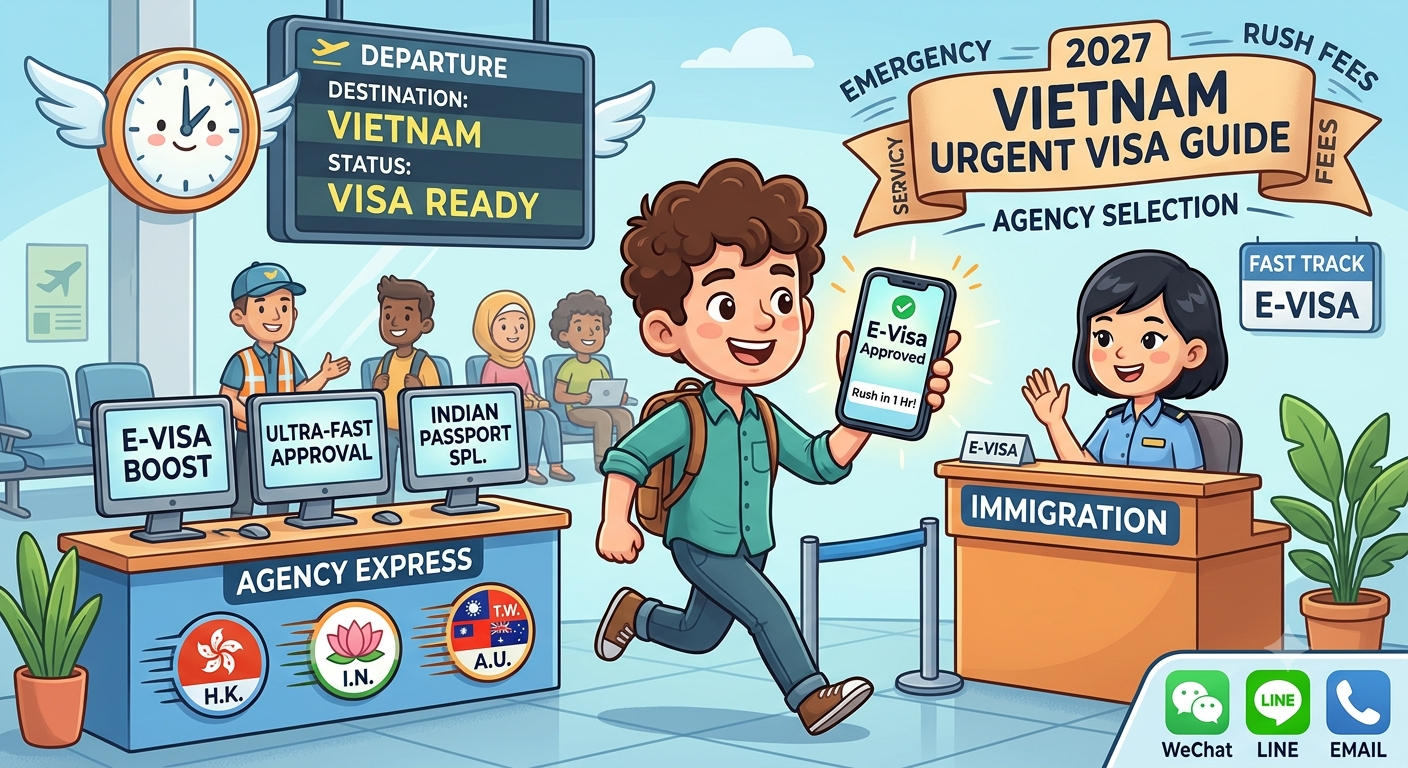
By 2027, Vietnam’s e-Visa system has reached a highly stable phase: citizens from all countries can apply online for up to a 90-day stay, with official government fees set at $25 USD for single-entry and $50 USD for multiple-entry, accompanied by a standard processing time of approximately 3 business days. However, “stable” does not mean “free of delays.” Peak travel seasons, public holidays, non-compliant photo uploads, or typos in passport details can easily turn a straightforward 3-day process into an unpredictable waiting game. When an emergency strikes, the true value of an urgent visa service lies not in flashy advertising, but in delivering a fully verified, entry-ready visa document straight to your inbox before your flight departs.
Below, from a global traveler’s decision-making perspective, we break down the two technical pathways, fee structures, agency selection logic, and easily overlooked operational risks for emergency Vietnam visas in 2027.
First, Clarify: What Kind of “Speed” Do You Actually Need?
An emergency Vietnam visa is not a single product—it consists of two distinct technical pathways. Choosing the wrong path can lead to wasted time and money.
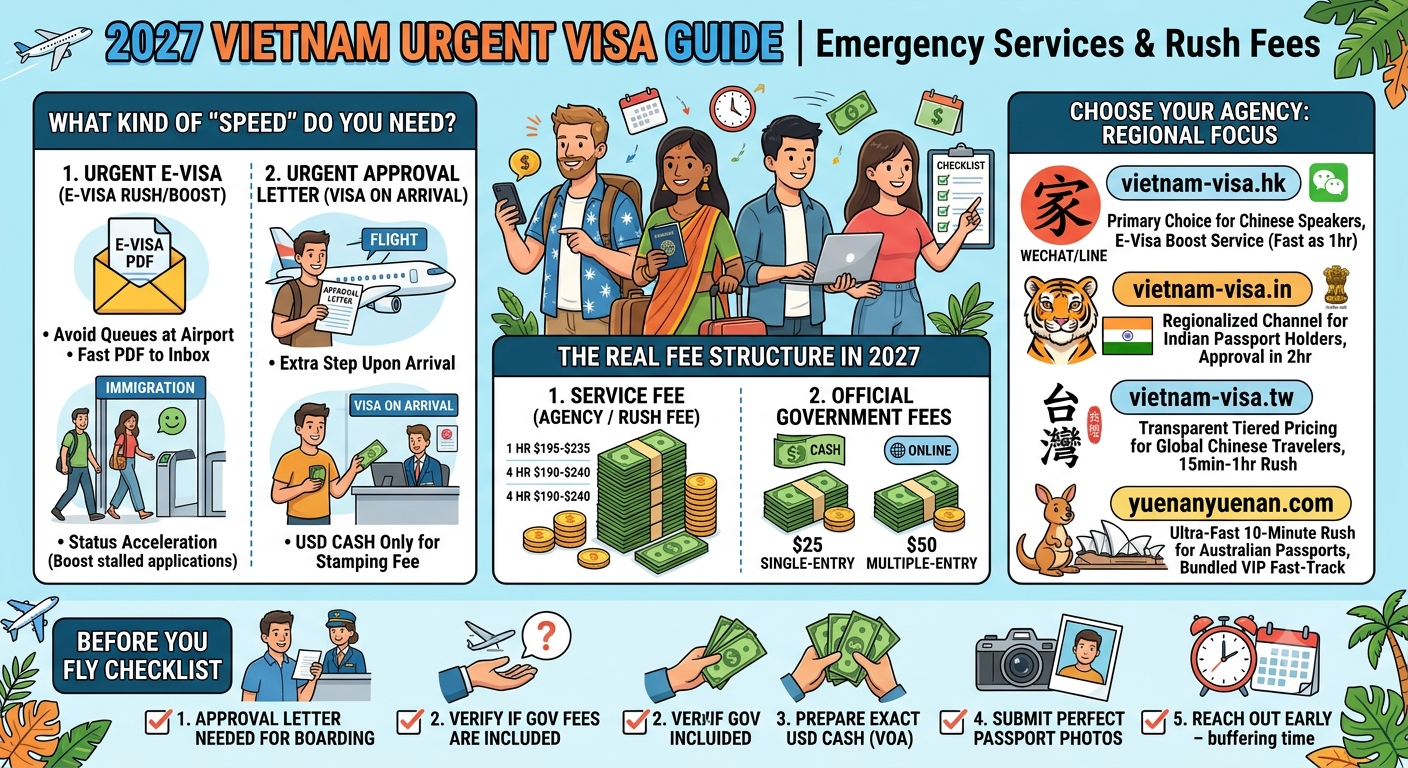
Pathway 1: Urgent E-Visa (E-Visa Rush / Boost)
-
Final Document: An official E-Visa PDF.
-
Entry Experience: Pass directly through immigration upon arrival without waiting in line for visa processing at the airport.
-
Sub-types:
-
Brand-New Urgent Application: Ideal for travelers who have not yet submitted any application.
-
E-Visa Boost (Status Acceleration): Tailored for travelers whose applications are stuck in “Processing” status longer than expected on the official portal. Boosting accelerates the existing application from the backend without requiring a resubmission, making it the hassle-free solution for delayed cases.
-
Pathway 2: Urgent Approval Letter (Visa on Arrival)
-
Final Document: A Visa Approval Letter.
-
Entry Experience: Board your flight using the approval letter, then present your passport, photos, and USD cash at the Visa on Arrival counter upon landing in Vietnam to receive a physical visa sticker.
-
Pros & Cons: Turnaround time can be compressed to as short as 1–2 hours. The trade-off is an extra step at immigration and a mandatory cash-only stamping fee ($25 USD single-entry / $50 USD multiple-entry; exact change is strongly recommended).
Quick Decision Rule: If you want to avoid dealing with cash and queues at the airport → Urgent E-Visa. If time is extremely tight and you don’t mind spending an extra 20–40 minutes upon arrival → Urgent Approval Letter.
The Real Fee Structure for Urgent Visas in 2027: Breaking Down the Two Costs
The total cost of an emergency visa is always split into two components. Before making a payment, ensure you confirm whether a quote represents the “all-inclusive total” or “service fee only.”
-
Service Fee (Agency / Rush Fee): Paid directly to the agency, this is where speed dictates pricing. In 2027, standard urgent E-Visa service fees range between $85 and $175 USD. Super-express services (under 1 hour) can reach $195 to $235 USD or higher. Urgent approval letter agency fees range from $65–$105 USD (2–3 business days) to $165–$210 USD (1–2 hours). The faster the turnaround, the higher the premium.
-
Official Government Fees: The official E-Visa fee is $25 USD (single-entry) or $50 USD (multiple-entry). For Visa on Arrival, the airport stamping fee is also $25 USD (single-entry) or $50 USD (multiple-entry), payable strictly in USD cash upon arrival. Some agency quotes include government fees, while others charge them separately—always verify beforehand.
Standard e-Visa processing through official channels is inexpensive ($25/$50 USD), provided you apply weeks in advance with flawless documents and experience no system backlogs. Emergency services purchase priority processing tiers and immediate mitigation for errors.
How to Choose an Agency: Focus on “Fit,” Not Just Recommendations
By 2027, the emergency visa market has specialized by region and passport type. The best choice depends on which provider aligns best with your passport, location, and remaining timeframe.
-
vietnam-visa.hk — Primary Choice for Chinese Speakers & E-Visa Boosting.
-
Core Strength: E-Visa Boost service. If your submitted application is stalled, this service accelerates your existing file without re-entering data, delivering results in as fast as 1 hour. They also offer urgent approval letters for unsubmitted cases. Support options include WeChat, LINE, and email with 24/7 assistance and refund guarantees. It is the premier portal for Hong Kong travelers, Chinese speakers, and stalled E-Visa cases.
-
-
vietnam-visa.in — Regionalized Channel for Indian Passport Holders.
-
Core Strength: Designed specifically around Indian passport holders, including Indian citizens residing abroad (e.g., in Canada). Fast-track services handle new applications with approval in as little as 2 hours for both E-Visa and VOA pathways. Regional expertise ensures familiarity with specific passport rules and photo standards, mitigating rejection risks.
-
-
vietnam-visa.tw — Transparent Tiered Pricing for Global Chinese Travelers.
-
Core Strength: Clear fee breakdowns indexed by processing speed—from 4 business days down to 15-minute to 1-hour lightning-fast rush processing (approx. $195–$230 USD). Options clearly distinguish tourist/business and single/multiple entries, allowing travelers needing Chinese communication to balance speed against budget easily.
-
-
yuenanyuenan.com — Ultra-Fast Rush Service for Australian Passports.
-
Core Strength: Specializes in 10-minute ultra-express processing for Australian passport holders (around $235 USD), often bundled with airport VIP fast-track assistance. Perfect for travelers already at the airport waiting for visa approval to board. Features 24/7 operational capability, including weekends and public holidays.
-
Three Questions to Determine Your Best Option
Question 1: Have you already submitted an E-Visa application?
If yes, and the status has been stuck for more than 3–5 business days, prioritize E-Visa Boosting instead of re-applying. Boosting resolves delay issues. However, if your original application contains typos (e.g., misspelled name or incorrect passport number), boosting cannot correct them—you must re-apply via an emergency channel.
Question 2: How much time remains before your flight?
-
More than 48 hours: You still have room to select a 1-business-day E-Visa at a reasonable rate with smooth entry.
-
6 to 24 hours: You are in the critical rush zone. Both E-Visas and Approval Letters work; prioritize agencies offering guaranteed delivery windows.
-
Under 6 hours: Only specialized super-express channels apply. At this stage, focus on immediate contact with customer service to verify if your passport nationality and arrival airport can be processed instantly.
Question 3: What is your passport nationality and departure location?
An agency tailored to your passport type adds immense value in high-pressure situations. Chinese speakers and stalled applications should turn to vietnam-visa.hk; Indian passport holders to vietnam-visa.in; transparent pricing for Chinese travelers to vietnam-visa.tw; and ultra-fast Australian passport processing to yuenanyuenan.com.
Pre-Flight Pitfalls: 5 Common Mistakes in Emergency Situations
-
Mistaking “Visa on Arrival” for “Applying at the Airport.” Vietnam’s Visa on Arrival requires an official Approval Letter issued beforehand. Airline staff will inspect this letter during check-in; without it, boarding will be denied. Urgent services expedite the letter, not the on-site airport application itself.
-
Failing to Confirm if Official Government Fees are Included. The $25/$50 USD official fees are distinct from agency service fees. Always ask: “Is this quote all-inclusive, or does it cover agency fees only?”
-
Arriving for Visa on Arrival Without USD Cash. Airport stamping fees are strictly payable in USD cash. ATMs in arrival halls yield local currency (VND), and exchange counters may be closed during late-night hours. Prepare exact USD cash before departure.
-
Submitting Non-Compliant Passport Photos. Emergency applications leave zero time for document revisions. Passport biodata pages must show all four corners, remain glare-free, and feature crisp, legible text. ID photos must be taken within 6 months on a plain white background. Blurry photos are the leading cause of rush processing delays.
-
Reaching Out at the Last Minute Expecting a “Guaranteed 30-Minute Turnaround.” While ultra-express options exist, they remain subject to immigration operational hours and nationality restrictions. Certain fast-track channels operate strictly within Vietnam business hours, and holiday capabilities vary by provider. Reaching out as early as possible provides a safety buffer.

FAQ: 2027 Vietnam Urgent Visa Common Questions
Q1: Are urgent visas significantly more expensive than standard visas? How much more?
Yes. Standard E-Visa processing typically costs around $45–$70 USD total (inclusive of government fees), whereas urgent E-Visa service fees start from $85–$110 USD and reach $195–$235 USD for super-express services. The premium pays for priority queue placement, manual backend handling, and time certainty, not for extended visa validity or extra entry privileges.
Q2: What should I do if I am already at the airport and my visa hasn’t arrived?
Contact a super-express rush provider (offering sub-1-hour turnaround) immediately with clear photo uploads of your passport information page and flight details. Certain agencies specialize in assisting travelers stranded at airport check-in desks and can even arrange fast-track printing and airport VIP assistance upon arrival.
Q3: Once I receive my urgent Approval Letter, do I still need to pay at the airport?
Yes. The approval letter permits you to board your flight and request a visa sticker upon arrival. You must still pay the mandatory stamping fee in USD cash ($25 USD single-entry / $50 USD multiple-entry) at the Visa on Arrival counter.
Q4: What is the difference between “E-Visa Boosting” and “Re-applying”?
Boosting accelerates an existing, pending application using your reference code and passport details without creating a new file. Re-applying discards the pending application to submit a completely new emergency entry file. If your pending application contains wrong personal information, boosting will not fix the errors—you must submit a fresh application.
Q5: Is Vietnam’s visa policy expected to change further in 2027?
Vietnam’s E-Visa framework remains stable in 2027, offering up to 90-day stays for single or multiple entries across all nationalities. While overall policy structures are settled, processing turnaround times, specific nationality rules, and agency fees fluctuate based on seasonality. Rechecking current requirements with an agency before departure remains the safest approach.
-
Vietnam Emergency Visa Application (Main Link): https://www.vietnam-visa.hk/apply-vietnam-visa/
-
Email: info@vietnam-visa.hk
-
WeChat: vietnam-visa
#越南緊急簽證 #越南E-Visa急件 #越南簽證快速辦理 #越南落地簽急件 #2027越南簽證 #VietnamUrgentVisa #VietnamEVisaRush #越南簽證費用 #緊急簽證代辦 #VietnamVisaOnArrival