2027 Vietnam Tourist Visa Complete Guide for Canadian Citizens | E-Visa Exclusive Guide, Phu Quoc Visa-Free Scheme, and Entry Tips
Although Vietnam and Canada are separated by the Pacific Ocean, direct flight routes have continued to expand in recent years. With increasingly convenient direct flights from Vancouver (YVR) to Ho Chi Minh City, Vietnam has become a top destination for Canadian travelers exploring Southeast Asia. From the French colonial charm and bustling streets of Ho Chi Minh City to the stunning coastline of Da Nang and the Golden Bridge in Ba Na Hills, and the historical Old Quarter of Hanoi accompanied by a comforting bowl of Vietnamese pho, each city offers a uniquely distinct travel experience. However, for Canadian passport holders traveling to Vietnam, securing a visa is the very first thing that must be handled before departure. This guide provides a complete overview of the latest 2027 Vietnam tourist visa regulations, exclusive considerations for Canadian applicants, application procedures, and entry tips to help you easily secure your visa and embark on a smooth journey.
I. Do Canadian Passport Holders Need a Visa?
Yes. As of 2027, Vietnam has not implemented a comprehensive visa-free policy for Canadian passport holders, nor has it included Canada in its 45-day visa-free country list. Whether traveling for tourism, family visits, or business, Canadian citizens must obtain a valid visa before entering Vietnam. Canada does not fall under Vietnam’s current unilateral visa-free arrangement scope.
⚠️ Important Reminder: Never assume you can “figure it out upon arrival”—airlines will not allow you to board without a visa.
1.1 Two Visa-Free Exceptions for Canadian Passport Holders
Phu Quoc Island Visa-Free
Phu Quoc is currently the only region in Vietnam that offers a visa-free stay of up to 30 days for Canadian passport holders. You must simultaneously meet all of the following conditions:
-
Passport validity must be at least 6 months from the date of entry.
-
Hold a confirmed return ticket or an onward ticket to a third country.
-
Fly directly into Phu Quoc International Airport (PQC), and your itinerary must remain strictly within the island.
-
Must not transit or enter mainland Vietnamese cities such as Hanoi or Ho Chi Minh City.
⚠️ Critical Trap: If you first fly to Ho Chi Minh City or Hanoi and then take a domestic connecting flight to Phu Quoc, the visa-free privilege becomes immediately void, and you must hold a full Vietnam visa. If your itinerary includes mainland cities like Da Nang, Hanoi, or Ho Chi Minh City, you must apply for a full Vietnam visa in advance, otherwise you may be denied entry.
APEC Business Travel Card (ABTC)
Canadian citizens holding a valid ABTC card can enter mainland Vietnam visa-free for a maximum stay of 90 days. This is a convenient option worth noting for Canadian business professionals.
1.2 Advantages of E-Visa for Canadian Passports
Canadian passports are fully eligible to apply for the Vietnamese Electronic Visa (E-Visa). If you hold dual citizenship featuring a Canadian passport alongside another, you should prioritize using your Canadian passport 100% to apply for the E-Visa—the process is smoother and faster.
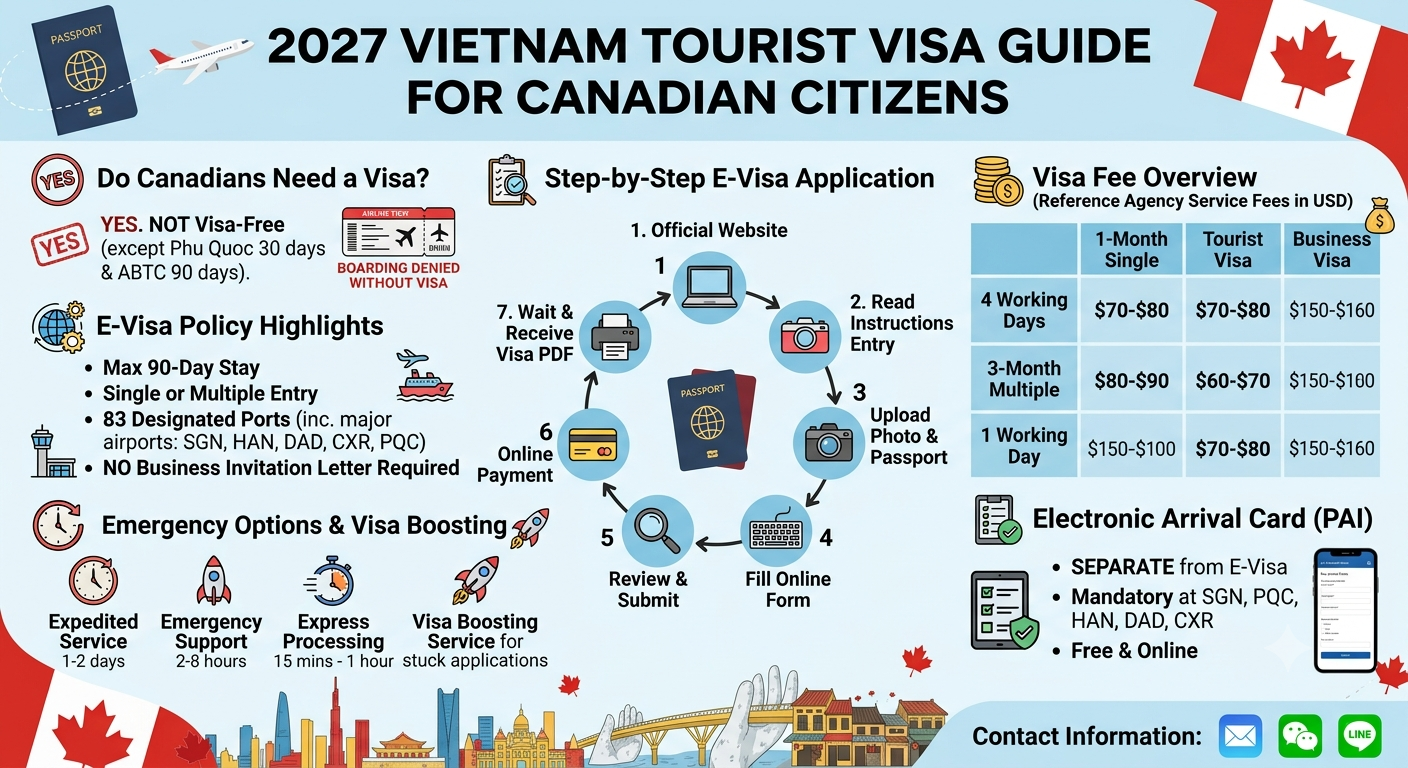
II. 2027 Vietnam E-Visa Policy Highlights (Applicable to Canadian Citizens)
Vietnam’s E-Visa policy underwent major reforms via Resolution No. 127/NQ-CP, with continued optimizations for 2027. Here are the core policies Canadian applicants must know:
III. Exclusive Considerations for Canadian Applicants
3.1 Name Input—The Most Common Error
The Vietnam E-Visa system has extremely strict formatting requirements for names. The most common mistakes made by Canadian applicants include reversing the Last Name and First Name, adding commas or hyphens on their own, and failing to match the Machine-Readable Zone (MRZ) of the passport precisely.
Correct Approach:
-
Last Name field: Enter your family name, e.g., SMITH, JOHNSON, BROWN.
-
First Name field: Enter your given names, including middle names, e.g., MICHAEL, SARAH JANE.
-
Use all capital English letters, matching the English spelling on your passport exactly.
-
If your passport contains hyphens, leave a space and remove the hyphen when typing.
Example: If your passport shows
SMITH MICHAEL JOHN, enterSMITHin the Last Name field andMICHAEL JOHNin the First Name field. Never reverse them toMICHAEL JOHN SMITH—this is the #1 reason for application rejections.
3.2 Photo Specifications—The Second Leading Cause of Rejection
The Vietnam E-Visa requires a 4×6 cm, solid white background photo, full-face, bareheaded, without glasses or hats, with facial features clearly exposed. Formatted as JPG or JPEG, file size under 2MB. Starting in 2026, the official system’s automated photo check has become significantly stricter—even a light gray kitchen wall that looks white to you may cause rejection. The system automatically compares the photo upon upload and displays a checkmark if passed; if it fails, please replace the photo.
3.3 Passport Requirements
Your passport must have a validity of at least 6 months from your date of entry and contain at least 2 consecutive blank pages for entry stamps.
IV. Pre-Application Document Checklist
Before filling out the application form, please prepare the following electronic files (smartphone photos are acceptable as long as they are clear):
V. Step-by-Step Application Guide (7 Easy Steps)
Visit the official Vietnam Immigration Department E-Visa website or apply through a professional agency website: https://www.vietnam-visa.in/apply-vietnam-visa/
Carefully read the application instructions, check the box to agree to the terms, and proceed to the application form.
Sequentially upload your compliant ID photo and passport information page scan. The system will automatically check if the photo passes.
Fill out personal information, passport details, entry port, visa type, and starting date item by item. Choose “Canada” as your nationality. Name spelling must match your passport exactly; a single letter error will cause processing delays.
Double-check all entered content before submission. Submit once confirmed accurate.
Pay using a credit card (Visa, Mastercard, JCB, and other international payment methods supported). Payment is billed in USD, and your credit card issuer will automatically convert it to CAD based on the daily exchange rate.
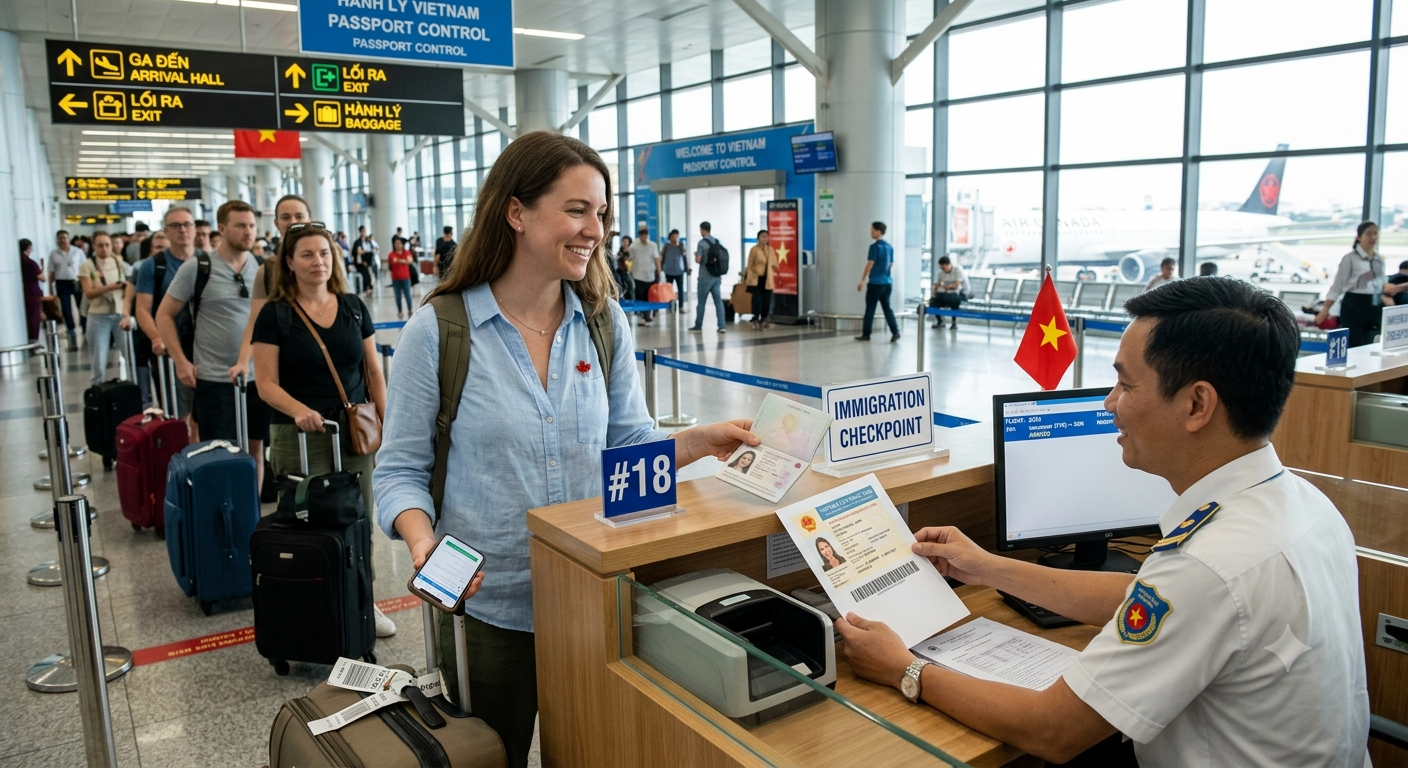
Once approved, the visa PDF will be sent to your provided email address. Be sure to print it out in color on A4 paper, as some Vietnamese border checkpoints do not accept digital files displayed on phones. Standard processing time is approximately 3 to 5 working days.
VI. E-Visa Fee Overview
Applying through a regulated agency website includes both agency support and government visa fees, with a visa success guarantee and timely delivery, or a full refund if unsuccessful. Below are reference agency service fees (in USD):
🌐 Apply Online via Agency Website: https://www.vietnam-visa.in/apply-vietnam-visa/
1-Month Single-Entry
3-Month Multiple-Entry
Note: The above figures represent agency service reference fees. Official basic government fees are extra ($25 USD for single entry, $50 USD for multiple entry).
VII. Emergency Processing Options
7.1 Common Emergency Scenarios
The most common sudden visa dilemmas faced by Canadian travelers include: realizing they have no visa once already at the airport, E-Visas status showing “Pending”, assuming visas can be arranged “upon arrival” in Vietnam, and official website applications getting stuck in review.
7.2 Vietnamese National Holidays Notice
The Vietnam Immigration Department is closed on weekends and national holidays. If you submit an application on a Friday afternoon or during a holiday, the system will accept the data, but actual review will not begin until the next working day. Major 2027 Vietnamese national holidays include: Lunar New Year (Tet), Hung Kings’ Festival, Liberation Day & Labor Day (April 30 – May 1), National Day (September 2), etc. If your departure date falls during a holiday period, it is strongly recommended to apply early or use expedited services.
7.3 Expedited Service Options
Even during weekends or Vietnamese national holidays, professional visa support channels can process Vietnam emergency visas rapidly, obtaining entry approval letters in as fast as 15 minutes. Canadian passport holders even have the opportunity to secure a Vietnam visa approval in just 4 hours.
7.4 Visa Boosting Service
If you have already applied on the official website and your status is stuck on “Processing”, you can use the visa boosting service to accelerate handling. This service is designed for official website application bottlenecks, unclear post-supplement statuses, and similar hurdles.
VIII. Electronic Arrival Card System
Starting in 2026, major international airports in Vietnam fully launched the Electronic Arrival Card system (PAI, Pre-arrival Information), requiring travelers to complete online personal data declarations prior to arrival.
Important Reminder: The Electronic Arrival Card and the E-Visa are two completely separate things. Even if you hold an E-Visa, you must still complete the electronic arrival card declaration separately. The proper sequence is: “Secure E-Visa first -> Get visa number -> Then fill out Electronic Arrival Card”.
-
Who Must Fill This Out: Foreign passport holders entering Vietnam (including Canadian passport holders), E-Visa or visa-on-arrival travelers, and Phu Quoc visa-free visitors.
-
Airports with Mandatory Implementation:
The PAI system is completely free. The official website ends in .gov.vn: https://prearrival.immigration.gov.vn. Travelers can use connected electronic devices to declare arrival times and locations up to 3 days prior to arrival. Filling this out in advance shortens entry inspection times and reduces waiting queues by over 30 minutes.
IX. Five Key Considerations for Canadian Travelers Applying for Vietnam Visas
-
Identify Official Websites to Avoid Scams
Official E-Visa websites end in
.gov.vn. Recently, fraudulent websites and illegitimate agency services have increased, leading to higher instances of personal data leakage and payment disputes. The Vietnam Immigration Department specifically reminds travelers to avoid unverified visa platforms and choose reputable service websites to ensure data security and valid visas. Applying through a regulated agency website grants professional customer support, typically delivering visas within 4 working days, and within 1 working day in emergencies. -
Strict Photo Specifications—A Primary Reason for Failure
Non-compliant photo specifications are a leading cause of rejections. Starting in 2026, the official system’s automated check is significantly tighter. The system checks uploads and outputs a checkmark if successful; if not, you must replace the photo.
-
Passport Requirements: 6-Month Validity & 2 Blank Pages
All visa types require: a passport validity of at least 6 months from the date of entry and at least 2 consecutive blank pages for entry stamps.
-
Entry Count Selection—Essential for Multi-Country Itineraries
If you plan to include other Southeast Asian countries in your vacation—for example: Canada -> Vietnam -> Thailand -> Vietnam -> Canada—this trip requires entering Vietnam twice. If you hold a single-entry visa, after leaving Vietnam the first time, you cannot assume the same single-entry visa will automatically work for a second entry. Therefore, if you are scheduling a multi-country itinerary combining Vietnam with Thailand, Cambodia, Singapore, or neighboring countries, map out your complete route first before deciding between single-entry and multiple-entry visas.
-
E-Visa Entry: Print a Hard Copy
Some Vietnamese border control customs do not accept digital files shown on phones. It is recommended to color print your E-Visa PDF on A4 paper and store it alongside your passport. Back up the digital file on your phone and email before departure in case the paper copy is lost.
X. Frequently Asked Questions (FAQ)
-
Q1: Do I need a visa if I am transiting through a Vietnamese international airport?
If travelers only stay within the international transit area of a Vietnamese airport without going through immigration clearance, and the layover time is less than 24 hours, a visa is generally not required. However, if you need to exit immigration to collect baggage, transfer to a domestic Vietnamese flight, or stay longer than 24 hours, you must apply for a valid Vietnam visa in advance.
-
Q2: Can a Vietnam E-Visa be extended while in the country?
E-Visas cannot be extended within Vietnam. If travelers need to extend their stay in Vietnam, they must apply for other types of visa categories in advance or leave Vietnam and re-submit a new visa application.
-
Q3: Can I take a side trip to Da Nang under the Phu Quoc visa-free exemption?
No. Phu Quoc’s visa-free policy applies strictly within the island. If your itinerary includes other regions of Vietnam (such as Da Nang, Hanoi, or Ho Chi Minh City), you must apply for a valid Vietnam visa in advance; otherwise, you may be denied entry.
-
Q4: Do Canadian citizens need to provide proof of financial funds when applying for a Vietnam E-Visa?
No. Vietnam E-Visa applications do not require proof of funds, employment letters, or round-trip flight bookings. You only need to prepare a passport scan, digital ID photo, and Vietnam contact details to complete the application.
-
Q5: What is the difference between the “Effective Date” and the “Issue Date” on a visa?
Vietnam visas list both an “Issue Date” and an “Effective Date”. Travelers may only enter Vietnam on or after the visa’s effective date. The visa validity is based on the approval date displayed on the E-Visa, rather than your actual arrival date or issuance date. The intended entry date filled out during application affects the visa’s effective date; always check whether the effective date matches your travel plans when receiving your visa to avoid boarding delays with an inactive visa.
-
Q6: Can Canadian citizens apply for a Visa on Arrival (VOA)?
Yes. Visa on arrival requires travelers to obtain an “Approval Letter” prior to boarding, and then collect the visa sticker upon arrival at a Vietnamese airport. However, VOA is restricted to air entries only; land borders do not accept VOA. For most Canadian travelers, the E-Visa remains the more recommended choice.
XI. Pre-Departure Final Checklist
Once you receive your visa, perform a quick yet important pre-departure master check:
-
Name ✓
-
Passport Number ✓
-
Personal Identity Information ✓
-
Visa Effective Dates ✓
-
Permitted Number of Entries ✓
-
Other Important Visa Content and Conditions ✓
Next, cross-check these with your entire travel plan: Does the visa validity cover your actual arrival time in Vietnam? If you are visiting Thailand or Cambodia and returning to Vietnam mid-trip, are your entry counts sufficient? Does the passport number on the visa match the passport you are actually bringing to the airport?
Spending a few minutes doing these checks allows you to catch potential issues well before departure.
XII. Contact Information
If you have any visa questions or require emergency assistance, you can directly contact our visa experts:
-
📧 Email: info@vietnam-visa.in
-
💬 WeChat: vietnam-visa
-
💬 LINE: https://line.me/ti/p/nqB711G8TX
-
🌐 Online Application: https://www.vietnam-visa.in/apply-vietnam-visa/
-
⚡ Visa Boosting Service (For stalled official website applications): https://www.vietnam-visa.in/boost-your-e-visa-application-form/
For Canadian travelers, handling a Vietnam tourist visa is less about memorizing every visa term and more about mastering the right sequence: map out your complete itinerary clearly, determine the appropriate entry method, prepare accurate materials, carefully complete your application, and finally re-check the content once the visa is approved. Incorporating your visa alongside your flights, accommodations, and transportation into your travel planning is typically much more relaxed than handling it last minute before departure. Allocating reasonable time for your application, double-checking your passport details, and seeking proper professional assistance when needed ensures that once your visa is sorted, the real question worth pondering becomes something much more exciting: “Should we stay an extra night in Da Nang, or leave that day for Hoi An?”
#VietnamVisa #VietnamEVisa #CanadianCitizensVietnamVisa #VietnamTravelGuide #PhuQuocVisaFree