2027 Vietnam Urgent Visa Complete Guide for Mainland Chinese Citizens: Accelerated Processing, Boost Fees & Agency Process
As of 2027, Vietnam has not implemented full visa-free entry for holders of ordinary mainland Chinese passports; therefore, a valid visa must be obtained prior to departure. The Electronic Visa (E-Visa) is open to citizens worldwide, allowing Chinese passport holders (both old “G” prefix and new “E” prefix passports) to complete the application process entirely online for stays of up to 90 days, with options for single or multiple entries.
However, mainland Chinese passport holders face a crucial step that distinguishes them from almost all other nationalities: after your E-Visa PDF is approved, you must still present yourself at the “Visa on Arrival” counter upon landing at a Vietnamese airport to receive a free Loose-leaf Visa before proceeding to passport control for entry stamping. This means a critical preparatory step lies between “receiving the E-Visa PDF” and “successfully entering the country.” Under emergency circumstances, where time pressure is compounded by this extra step, choosing the correct acceleration path is far more important than mere price comparison.
I. Why “Urgent” is Different for Chinese Passports: Understand the Two Unique Procedures
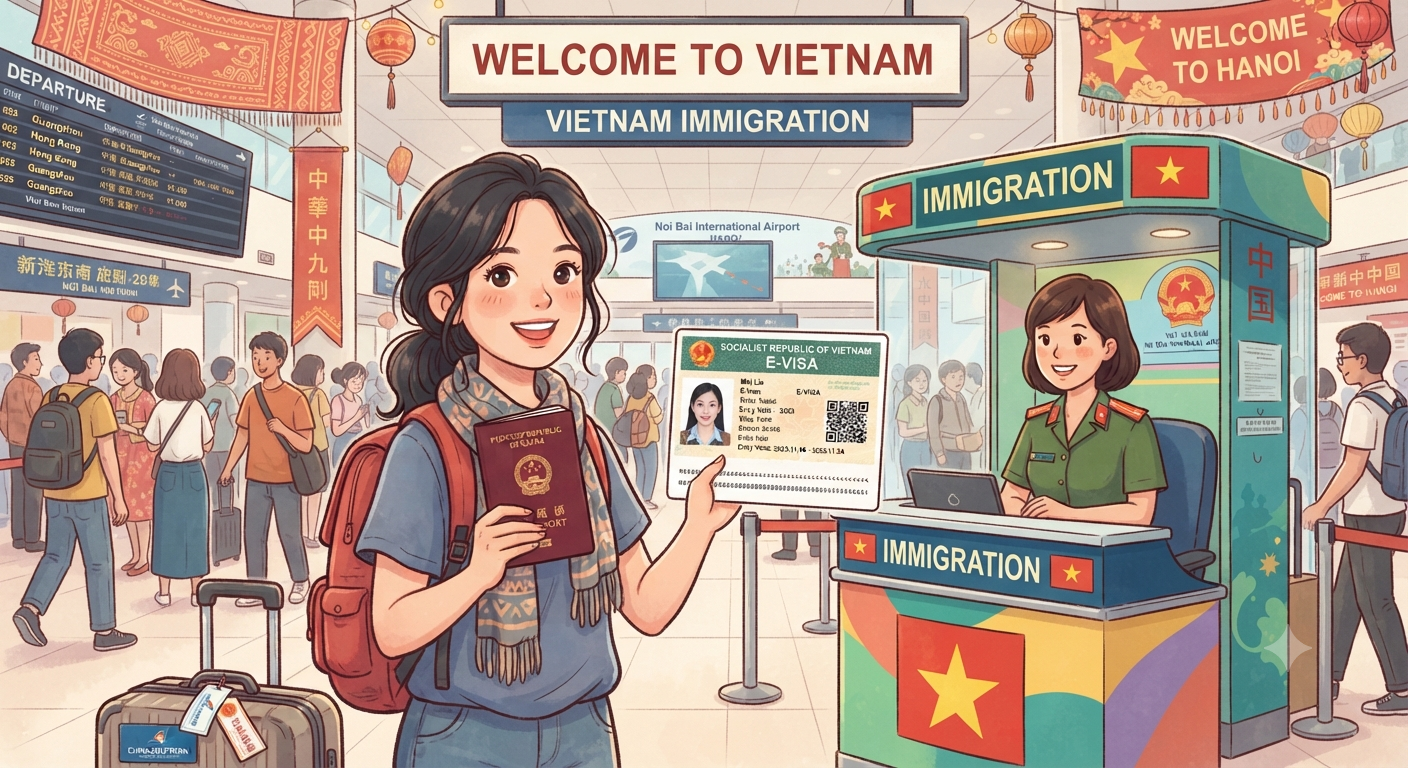
Unlike most global passport holders who can pass through border control directly with their printed E-Visa PDF, mainland Chinese passport holders cannot. Regardless of whether you hold a “G” or “E” prefix passport, your first stop after landing at a Vietnamese airport with an approved E-Visa is the “Visa on Arrival / Landing Visa” counter. You must present your passport, printed E-Visa, and two 2-inch white-background photos (approx. 4×6 cm) to obtain a free Loose-leaf Visa before joining the line at immigration. While the loose-leaf visa itself is free of charge, queue times can be long during peak hours, making it vital to factor this wait time into an urgent itinerary.
Another easily overlooked step is the PAI Electronic Arrival Card. Vietnam has implemented Pre-arrival Information filing at key international airports including Ho Chi Minh City (SGN), Hanoi (HAN), Da Nang (DAD), Nha Trang Cam Ranh (CXR), and Phu Quoc (PQC). This declaration can only be completed within 72 hours prior to arrival; filling it out too early will cause the generated QR code to expire. Travelers who fail to complete it beforehand will be required to fill it out on site, further slowing down their entry clearance.
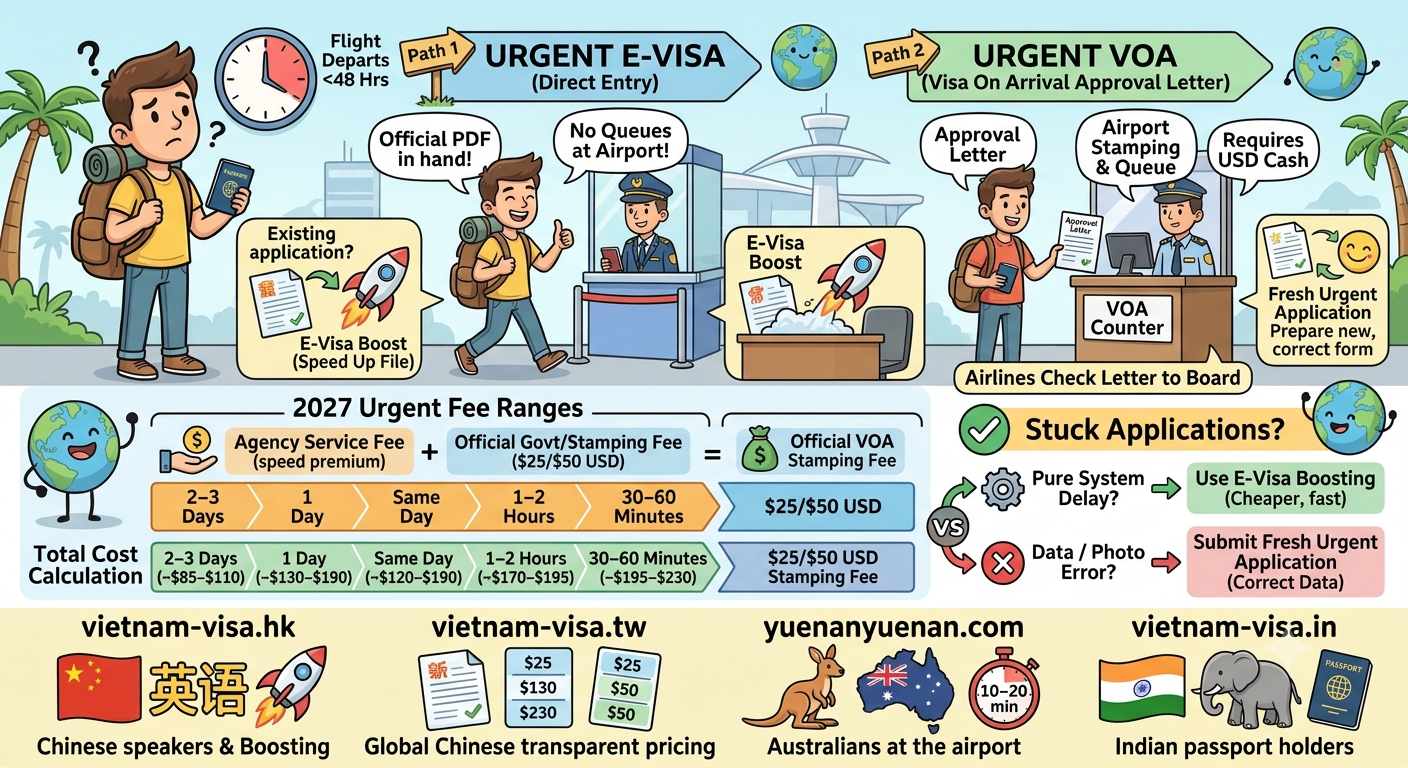
What this means for urgent applicants: If you choose the “Visa on Arrival Approval Letter” route, you will use the approval letter at the Visa on Arrival counter upon arrival to obtain a physical visa sticker, which involves queuing and paying stamping fees ($25 USD for single entry, $50 USD for multiple entry in cash). If you choose the “Urgent E-Visa” route, you will exchange your documents for a free Loose-leaf Visa upon arrival without paying additional stamping fees, but you must still prepare your photos and budget time for queuing. The two routes speed up different parts of the journey: the approval letter accelerates pre-departure processing, whereas the E-Visa accelerates the post-arrival experience by eliminating cash transactions at the airport.
II. 2027 Urgent E-Visa Fee Overview for Chinese Passports: All-Inclusive Pricing is the Real Metric
Total emergency visa expenses consist of official government fees and agency/expedited service fees. Government fees are fixed: $25 USD for single entry and $50 USD for multiple entry. The significant price variance comes from service fees. For Chinese passport applicants, the key question to verify is whether a quoted price is “all-inclusive” or “service fee only.”
Below are the 2027 all-inclusive reference prices offered by vietnam-visa.hk for mainland Chinese passport holders (inclusive of government fees and agency service fees; no additional official fees are required upon arrival, and Chinese passport loose-leaf visa issuance at the airport is free):
1-Month Single Entry (Tourist / Business)
| Processing Time | Tourist Visa (USD) | Business Visa (USD) |
| 4 Working Days | $70 | $80 |
| 3 Working Days | $90 | $100 |
| 2 Working Days | $110 | $120 |
| 1 Working Day | $150 | $160 |
| 4 Working Hours | $190 | $200 |
1-Month Multiple Entry (Tourist / Business)
| Processing Time | Tourist Visa (USD) | Business Visa (USD) |
| 4 Working Days | $100 | $110 |
| 3 Working Days | $120 | $130 |
| 2 Working Days | $140 | $150 |
| 1 Working Day | $180 | $190 |
| 4 Working Hours | $220 | $230 |
For urgent time windows exceeding 4 hours but under 1 business day, market rates generally fall into these brackets: Super Urgent (1–2 hours) at $170–$195 USD, and Same-Day Urgent (4–8 hours) at $120–$190 USD. Flash Rush Service (30 mins–1 hour) can reach $195–$230 USD, tailored for scenarios where the applicant is already at the airport departure counter before check-in closes.
Decision Logic: If your flight is more than 24 hours away, the 1-working-day all-inclusive option ($150 USD for single entry) offers the best cost-to-speed ratio. If your flight departs within 6–8 hours, the 4-working-hour tier ($190 USD for single entry) is the realistic threshold to receive your PDF in time for printing. If you are already at the airport, flash rush service is your only option; at that stage, price is secondary to whether the provider can handle your specific passport type and arrival airport.
III. E-Visa Boost vs. Reapplication: Navigating Application Stalls for Chinese Passports
The most critical mistake a Chinese passport applicant can make when an application stalls in the official system is submitting a duplicate application. Reapplication will not speed up the process; instead, it risks flagging your details as a duplicate system error and delaying approval further. Your first step should always be assessing the underlying cause of the delay.
1. E-Visa Boost (Speed Up Existing Application)
This applies when your submitted details are accurate, but official processing has stalled. You already possess a Registration Code from the official portal, and your status reflects “Processing” beyond the expected timeframe without any notification requesting corrections. A boost operation works by submitting your original Registration Code, passport details, date of birth, and target delivery time to a service provider, who accelerates the existing file directly within the system background rather than starting anew. vietnam-visa.hk offers boost options across 1-hour, 2-hour, 4-hour, 1-day, and 2-day tiers, supporting payment via credit card, WeChat Pay, and Alipay for Chinese applicants.
2. Reapplication (New Urgent Application)
Reapplication is required when substantial errors exist in the original filing: inverted name order (swapped Surname/Given Name), typos in the passport number, incorrect port of entry, or system-rejected photos that were never rectified. A boost cannot fix data errors; in these instances, you must abandon the original application and launch a brand-new urgent request.
Rule of Thumb: Status simply “slow” with zero error notifications $\rightarrow$ Boost. Received revision/error alerts or noticed a typo yourself $\rightarrow$ Reapply. If you are unsure, send your original Registration Code and passport info page to customer service so they can advise whether to accelerate or reapply.

IV. Step-by-Step Agency Process: Five Critical Control Points for Chinese Passports
V. Pre-Departure Pitfalls: Five Common Traps for Urgent Applicants
-
Trap 1: Treating the E-Visa PDF as an Immediate Entry Stamp
For mainland Chinese passport holders, an E-Visa PDF alone does not grant direct entry. You must present it at the airport counter to obtain your Loose-leaf Visa before proceeding through immigration controls. Failing to account for this 20–40 minute window can lead to missed connections or transfer transport.
-
Trap 2: Arriving Without Physical White-Background Photos
Obtaining a Loose-leaf Visa requires two 2-inch white-background photos. Airport photo services can be expensive and feature long lines; do not rely on on-site photography during an urgent trip.
-
Trap 3: Discrepancy Between Name Format and MRZ
This is a hidden trap: your visa status may show as “Approved,” yet airline check-in agents or immigration officers may deem it invalid due to an MRZ mismatch. Verify your details letter-by-letter against the bottom
<<<<lines of your passport before submitting. -
Trap 4: Misunderstanding “Visa on Arrival” as Processing Upon Arrival
An approval letter or E-Visa must be secured prior to boarding your flight. Airline ground crews will check for approved documentation during check-in; without it, boarding passes will not be issued.
-
Trap 5: Calculating Processing Schedules During Vietnamese Holidays
The Vietnam Immigration Department does not process standard E-Visa applications on weekends or public holidays. Key holiday periods in 2027 include Lunar New Year (Feb 4–Feb 10), Hung Kings Commemoration Day (Apr 16), Liberation Day & Labor Day (Apr 30–May 3), and National Day (Sep 2–Sep 3). If your travel coincides with these dates, standard “1 business day” processing may stretch over several calendar days, requiring you to request weekend/holiday emergency handling.
FAQ: 2027 Vietnam Urgent Visa for Mainland Chinese Passports
Q1: Do Chinese passport holders with an urgent E-Visa need to pay extra fees at the airport in Vietnam?
No. Chinese passport holders using an E-Visa present their documentation at the Visa on Arrival counter to receive a Loose-leaf Visa free of charge, with zero stamping or visa fees. However, you must provide two 2-inch white-background photos. This differs from the Landing Visa Approval Letter route, which requires paying an airport stamping fee in cash ($25 USD single entry / $50 USD multiple entry).
Q2: How do I choose between an E-Visa Boost and a Reapplication?
If your official application status reads “Processing” with no error alerts, provide your Registration Code to initiate a Boost. If your name order is flipped, passport numbers contain typos, entry ports are mismatched, or photos were flagged by the system, a boost cannot correct the data—you must submit a Reapplication.
Q3: I am already at the airport and my E-Visa is still pending. How fast can it be processed?
Flash Rush processing can deliver an approved visa within 30 minutes to 1 hour, with all-inclusive fees ranging from $195 to $230 USD. Contact customer support immediately with your passport bio page, flight details, and existing Registration Code (if available) to confirm real-time processing feasibility for your specific airport.
Q4: Can I use an urgent E-Visa when crossing into Vietnam via land borders from China?
Yes, provided you cross through an officially designated land port of entry. The entry port selected during your E-Visa application must match your actual crossing location. Major land crossings such as Friendship Pass (Hữu Nghị) and Dongxing (Móng Cái) accept E-Visas, though non-designated minor border posts do not.
Q5: What is the difference between the $70 USD tier and the $190 USD tier?
The price difference reflects processing priority rather than visa conditions. A $70 USD application (4 working days) and a $190 USD application (4 working hours) yield identical E-Visas regarding validity period, allowed entries, and maximum stay duration. The price premium covers background queue prioritization and expedited handling for tight travel schedules.
Primary Application Link: https.www.vietnam-visa.hk/apply-vietnam-visa/
#Vietnam emergency visa #China passport Vietnam visa #Vietnam E-Visa urgent #Vietnam visa urging #2027Vietnam visa #VietnamUrgentVisa #VietnamEVisaRush #Chinese citizen Vietnam visa #Vietnam additional paper visa #Vietnam visa fee #Emergency visa agency